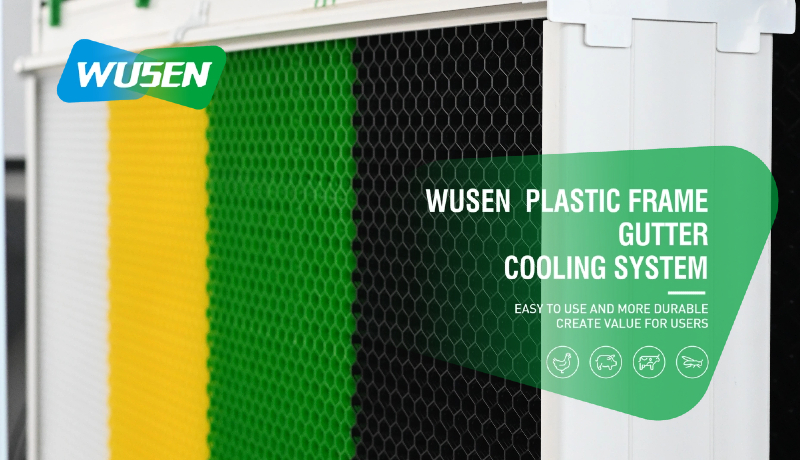
The Advantages of Plastic Cooling Pads
Why Plastic Cooling Pads Are Gaining Popularity
1.1 Core Issues with Cellulose Cooling Pads
Traditional evaporative cooling pads are typically made from rigid cellulose or corrugated paper. While they offer excellent saturation efficiency—reaching up to 93% under controlled laboratory conditions—they suffer from well-known drawbacks in practical applications. Cellulose pads are prone to deformation and shrinkage after repeated wet-dry cycles, and their fibrous structure tends to trap dust and mineral scale, which cannot be removed through cleaning. In continuous agricultural use, a typical paper-based cooling pad has a lifespan of only three to four years.
1.2 Advantages of Plastic Cooling Pads
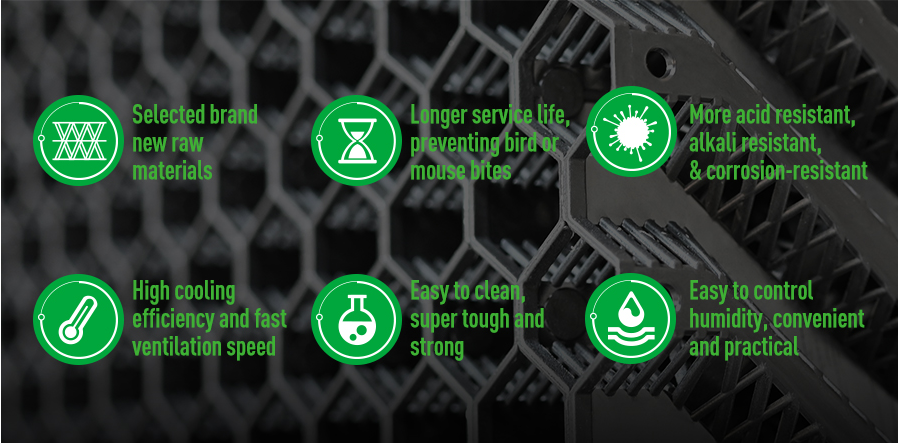
Plastic evaporative cooling pads, usually manufactured from virgin polypropylene, are designed to eliminate these failure modes. Their dual-layer corrugated, cross-structured design increases both the contact area with water and the total evaporative surface area. Furthermore, the robust polymer structure resists bending and warping, even in large-scale installations. Additionally, their cooling performance does not degrade over time due to the accumulation of dust.

Performance Data: What the Numbers Reveal
Independent testing of plastic media in evaporative cooling applications has yielded compelling results. One study compared a plastic-media cooling unit against cellulose pads of four different geometries. It found that the plastic media produced a pressure drop of only 11.05 Pa (at 2 m/s)—51% to 95% lower than that of the cellulose pads tested. Crucially, this low pressure drop remains unaffected by increases in water flow rate, ensuring consistent airflow resistance across various operating conditions.
The same study reported a saturation efficiency of 82.63% for the plastic-media unit, compared to an average of 65% for the cellulose pads. Water consumption was also lower, at approximately 3.05 L·h⁻¹·m⁻²·°C⁻¹. These data indicate that plastic media can provide cooling performance comparable to—or even better than—cellulose media, while simultaneously reducing the fan power required to move air through the cooling pads; this is a critical advantage for large-scale greenhouses and poultry farms, where fans operate continuously.