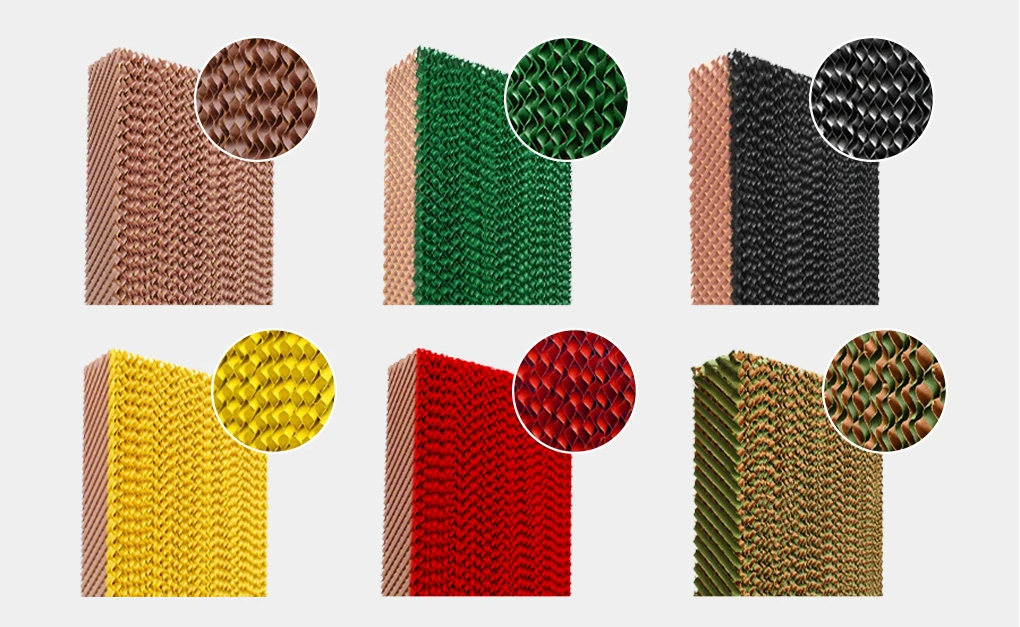
Coated vs. Uncoated Evaporative Cooling Pads: What the Coating Really Delivers
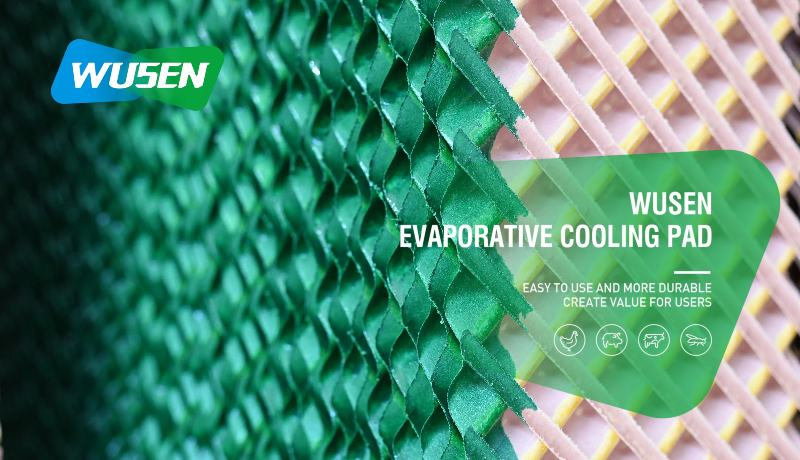
A coating on an evaporative cooling pad is not a cooling-performance enhancer. It will not make the air colder or raise the pad’s saturation efficiency in any meaningful way. What a properly formulated coating does deliver is protection—against algae, mineral anchoring, and UV degradation—that keeps the pad closer to its original performance for longer. For buyers specifying pads for agricultural, greenhouse, or industrial cooling, that distinction is the difference between choosing a maintenance strategy and choosing a cooling capacity.
The Physics Doesn’t Change
Evaporative cooling pads lower air temperature by maximizing contact between air and a wetted surface. Saturation efficiency is governed by pad geometry, thickness, water distribution, and air velocity. A surface coating that sits on the air-entering face does not alter these variables. It does not add evaporative surface area. It does not change the wet-bulb depression of the incoming air.
According to product documentation, the coating is “non-porous and quick-drying”; it prevents algae and minerals from adhering to the substrate and provides resistance to UV radiation, thereby extending the service life of the cooling pad. The core cooling characteristics—high efficiency and low pressure drop—are attributed to the design of the cooling pad itself, rather than to the coating.
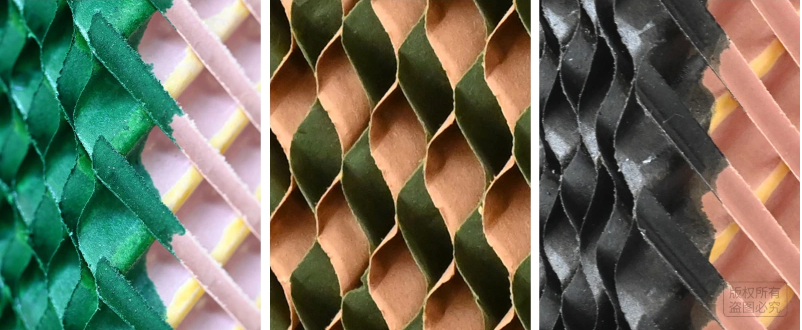
The Value of Coatings
The value of a coating depends on the severity of the operating environment and the level of maintenance that the system can realistically receive in practice.
Control of Algae and Minerals. In regions with hard water or environments subject to frequent wet-dry cycles, uncoated evaporative cooling pads are prone to algae growth and mineral scaling. Once algae attach to the cellulose substrate, they clog the air channels, causing an increase in static pressure; the fan must then work harder to maintain the required airflow. A non-porous, quick-drying coating, however, fundamentally prevents algae from taking hold.
If left unchecked, algae will “clog the channels and obstruct airflow.” By preventing such performance degradation—specifically, by avoiding factors that diminish cooling efficiency—coatings serve to protect the system’s cooling performance. UV Resistance and Weatherability. The air-intake side of a cooling pad is directly exposed to sunlight and the elements. UV-resistant coatings help delay material embrittlement and surface degradation—issues that often shorten the service life of pads installed outdoors or in semi-outdoor environments.
Washability. Coated cooling pads are designed to withstand repeated cleaning without damaging the surface treatment. In environments where hygiene is critical—such as poultry houses or food processing facilities—this durability allows for longer intervals between replacements.
Coated cooling pads offer superior resistance to moisture, UV exposure, and deformation, making them well-suited for demanding environments where a long service life is required. Conversely, uncoated pads, with their pure cellulose structure, provide optimal water absorption, making them ideal for applications where traditional, core performance characteristics are the primary requirement. Neither option is inherently better; the choice depends on the specific types of performance failure a user wishes to avoid.